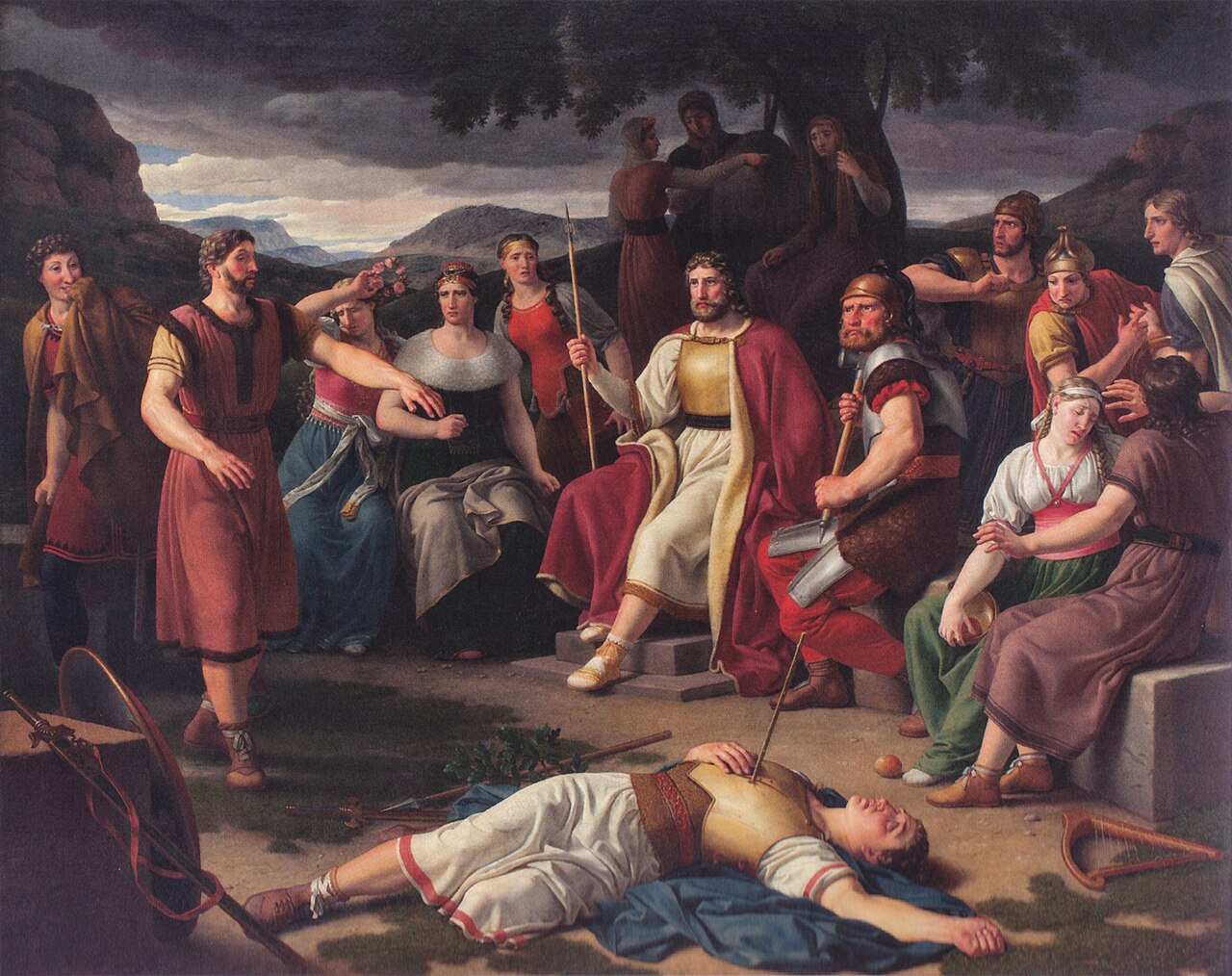
Son of Odin and Frigg. Slain by his brother Höðr with a shot of mistletoe orchestrated by Loki.
Baldr (Old Norse Baldr) is the son of Odin and Frigg, described as the most beautiful and pure of the Aesir. Snorri writes in Gylfaginning 22 that 'he is so fair of face and so bright that light shines from him'. His characteristics, beauty, goodness, and unfortunate innocence, make him one of the most interpreted figures in Norse mythology, frequently compared to dying and rising deities in Mediterranean religions.
Baldr's mythological fate centers on his inevitable death. He is plagued by dreams foretelling his destruction (Baldrs draumar 1-3), and Frigg secures oaths from all things not to harm her son. The mistletoe is overlooked. Loki fashions a dart from it and places it in the hand of the blind Hodr during the Aesir's game of hurling weapons at the invulnerable Baldr. The mistletoe kills Baldr (Völuspá 31-33, Gylfaginning 49).
The burial description in Gylfaginning 49 is among the most detailed in Old Norse prose. Baldr's body is placed on the ship Hringhorni, the greatest of all ships; Odin's ring Draupnir and Frigg's rings and necklaces are placed with him. The giantess Hyrrokin launches the ship. Hermod rides to Hel on Sleipnir to negotiate Baldr's return; Hel promises to release Baldr if all things in the world weep for him. All things weep except the giantess Thokk (Loki in disguise).
Baldr is prophesied to return after Ragnarok together with Hodr, and they will dwell on Odin's former sanctuary (Völuspá 62, hropts sigtóptir). Snorri's account in Gylfaginning suggests Baldr symbolizes a rebirth beyond destruction. Some scholars (Schjødt, Lindow) emphasize that Baldr's myth is primarily an initiation narrative or a myth of ritual sacrificial death, rather than a soteriological parallel to Christian resurrection themes.
Sources in the Eddas
- Völuspá 31-33
- The seeress describes Baldr's fatal wounding by mistletoe and the gods' grief; Loki's role is mentioned.
- Völuspá 62
- After Ragnarök Baldr and Höðr return and dwell in the renewed world.
- Baldrs draumar 1-14
- The short poem about Baldr's evil dreams and Odin's ride to Hel to question a dead seeress about their meaning.
- Lokasenna 27-28
- Frigg invokes Baldr in the flyting context; Baldr's position as the beloved but slain son is indirectly referenced.
Interpretive traditions
A What we know
Baldr was killed by Hodr using a mistletoe dart provided by Loki; this is attested in Völuspá 31-33 and Gylfaginning 49.
He was buried on the ship Hringhorni; Hermod unsuccessfully negotiated his return from Hel.
Baldr is prophesied to return after Ragnarok (Völuspá 62).
B What we think we know
Saxo Grammaticus tells a version of the Baldr myth in which Baldr and Hodr are rivals for a woman; whether Saxo's version is older or secondary is debated.
Whether Baldr's myth preserves traces of a historical cult practice, such as a ritual sacrificial killing, is debated (Frazer, Schjødt).
C What we do not know
Whether a historical Baldr cult with dedicated temples or rituals existed in Scandinavia is unknown.
The theological significance of mistletoe being specifically chosen as the death weapon is not explained in the sources.