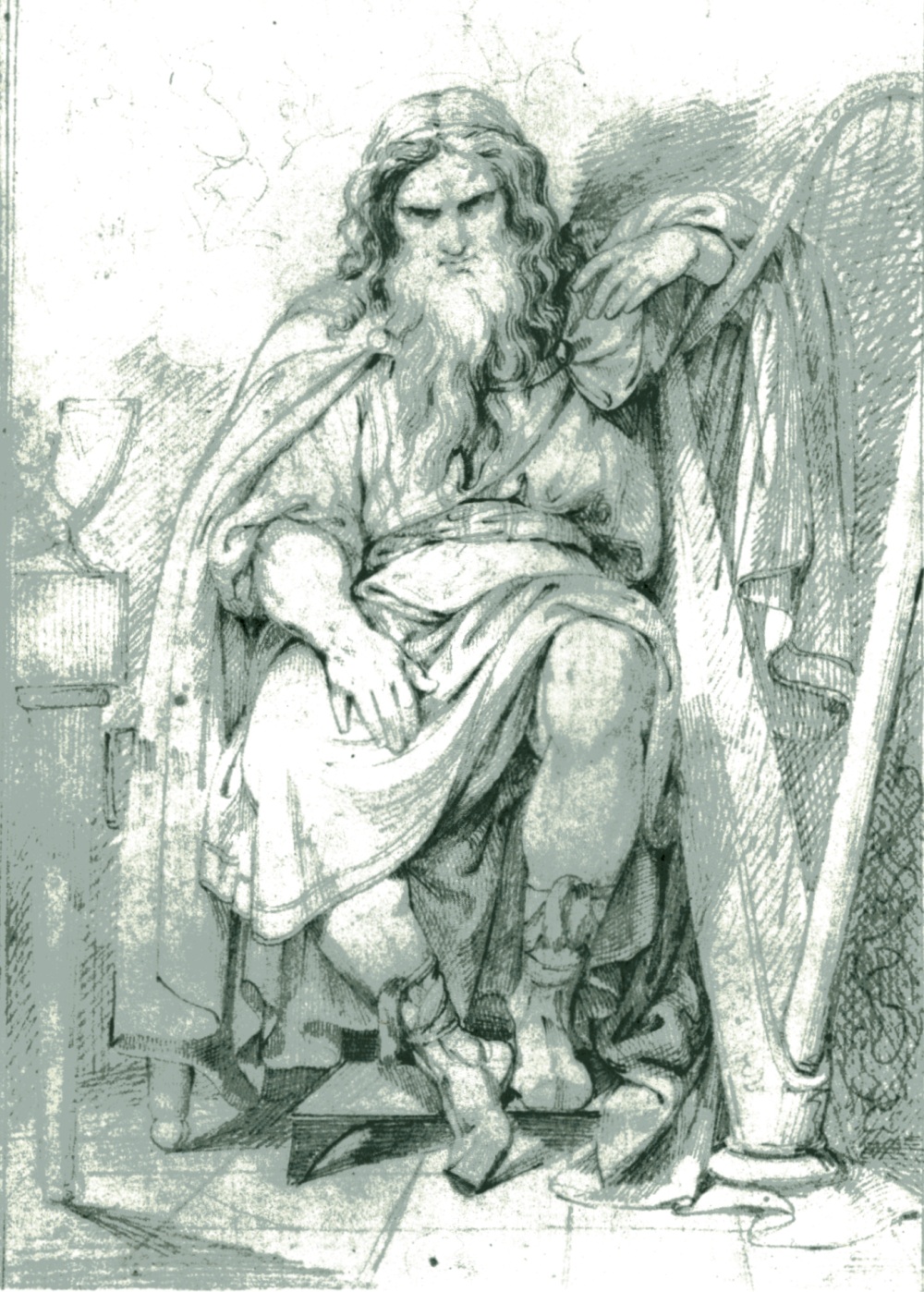
God of poetry. In Skáldskaparmál he instructs Ægir in the language of verse.
Bragi (Old Norse Bragi) is the god of skaldic poetry and one of the Aesir. His name is etymologically linked to Old Norse bragr, 'poetry' or 'song'. He is the husband of Idunn and one of the better-documented Aesir in poetic and mythographic tradition. Snorri Sturluson identifies Bragi with Bragi Boddason, the oldest known skald, whose works have been dated to the 9th century; whether the deity arose from the historicization of the poet or vice versa is debated.
In Lokasenna Bragi's behavior is characteristic: he is the first to wish to preserve the peace and avoid confrontation with Loki (Lokasenna 11-14). He offers Loki gold and silver to keep the peace, but Loki dismisses him as the most cowardly of the Aesir. Bragi's response is indignant but ineffectual; his wife Idunn must intervene to calm the conflict. The portrait is of a god whose domain is art rather than physical combat.
In Skáldskaparmál ch. 1 Bragi sits in Aegir's hall and tells mythological stories to Aegir; his function is explicitly narrative. He instructs on the kennings of skaldic art and its mythological frame of reference. Haustlöng and Ragnarsdrapa are skaldic poems incorporating mythological scenes, and in their context Bragi's divine mandate functions as the source of poetic art.
Bragi is named in Grímnismál 44 as the best of poets. Lokasenna 11 and Sigrdrífumál 16 link him to the tradition of runes carved on the tongue for skaldic art. His role in welcoming einherjar to Valhalla with poetry is implied in prose sources. The onomasticon yields human skaldic names compounded with the Bragi root, attesting to his cultic or honorary position within Norse poetic tradition.
Sources in the Eddas
- Lokasenna 11-16
- Bragi meets Loki and offers peace with gold; Loki accuses him of cowardice. Idunn intervenes to soften the conflict.
- Grímnismál 44
- Bragi is named as the best of poets among the gods.
- Sigrdrífumál 16
- Sigrdrífa mentions ale-runes carved on Bragi's tongue as the source of skaldic inspiration.
Interpretive traditions
A What we know
Bragi is the god of skaldic poetry and is consistently named the best poet among the Aesir (Grímnismál 44, Lokasenna).
He is married to Idunn and appears as the spouse of the keeper of the apples.
His narrative role in Skáldskaparmál is to instruct Aegir in mythology and kenning lore.
B What we think we know
Snorri's identification of Bragi with the historical skald Bragi Boddason (ca. 800s) is questioned by some scholars who argue that the deity existed independently of the historical person.
Whether Bragi had an independent cult or is merely a narrative projection of the skaldic ideal has not been settled.
C What we do not know
Whether Bragi was worshipped with dedicated cult sites or whether his veneration was expressed instead within skaldic practice itself is unknown.
The runes on the tongue (Sigrdrífumál 16) are mythologically obscure; the exact ritual or narrative basis for them is unknown.