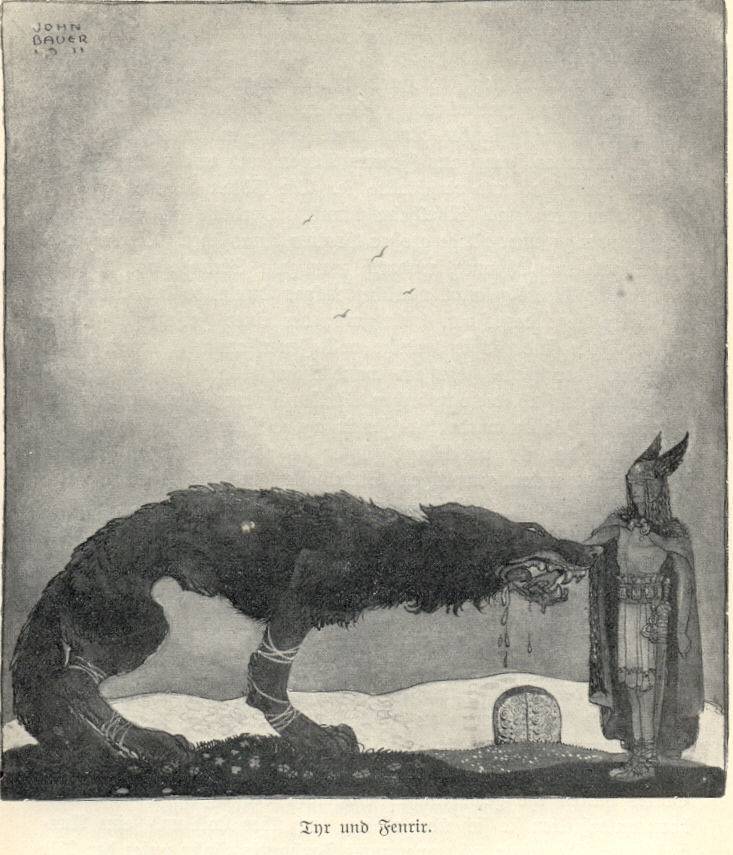
Son of Loki by the giantess Angrboða. Bound with Gleipnir; breaks free at Ragnarok and swallows Odin.
Fenrir, also called Fenrisulfr, is Loki's son by the giantess Angrboða and the mightiest of wolves in Old Norse myth. His father Loki produces with Angrboða three fateful offspring: Fenrir, Jörmungandr, and Hel. The gods, aware of the prophecy concerning these beings' role at Ragnarok, decided to raise Fenrir among themselves in Asgard, but his rapid growth forced them to act.
The binding of Fenrir is one of the most dramatic episodes in Old Norse myth. The gods attempted to bind him with the iron chains Leyding and Dromi, but Fenrir broke free from both. The dwarves of Svartalfaheimr then forged Gleipnir, a soft fetter made from six things that do not exist: the sound of a cat's footstep, the beard of a woman, the roots of a mountain, the sinews of a bear, the breath of a fish, and the spittle of a bird. Fenrir agreed to be bound by this invisible band, but only if a god placed his hand in his jaws as a pledge. Only Tyr dared, and paid with his hand.
At Ragnarok Gleipnir bursts and Fenrir rushes forward with his jaws gaping from earth to sky. He swallows Odin, the world-father's end. Odin's son Vidarr, who has borne the silence of vengeance, then kills Fenrir by stamping his thick shoe against the wolf's lower jaw and driving his sword into the wolf's palate. This scene is depicted in Völuspá 53-56 and reflects a deep theme of dynastic retribution.
Fenrir symbolizes in mythology the uncontrollable natural forces that can be bound temporarily but not annihilated. His inevitable release and the ultimate chaos he represents are bound up with Ragnarok's core theological message: that order is temporary and destruction ordained, yet a new world-order can arise from the ashes.
Sources in the Eddas
- Völuspá 39-40, 53-56
- Describes Fenrir's release and his swallowing of Odin, together with Vidarr's vengeance.
- Vafþrúðnismál 46-47
- Confirms that Fenrir will swallow Odin at the end of time.
- Lokasenna 38
- Loki enumerates his fearsome offspring, including Fenrir.
- Gylfaginning 34
- Snorri's complete prose narrative of Fenrir's upbringing, binding, and Tyr's hand.
- Hymiskviða 23
- Side-reference to Loki's wolf-offspring in the context of the fishing adventure.
Interpretive traditions
A What we know
Fenrir is Loki's son by Angrboða, bound with Gleipnir after breaking free from Leyding and Dromi.
Tyr sacrificed his hand as a pledge at the binding, a fact consistently attested in the sources.
At Ragnarok Fenrir swallows Odin and is slain by Vidarr.
B What we think we know
It is debated whether Fenrir has roots in an older Indo-European apocalyptic wolf-myth or whether the figure is specifically Norse.
The relationship between Fenrir and the everyday wolves' role in Old Norse mythological thought has not been fully clarified.
C What we do not know
It is unknown whether Vidarr's shoes were objects of cultic attention in pre-Christian times.
The mythological motivation for Gleipnir's six ingredients has not been fully explained.