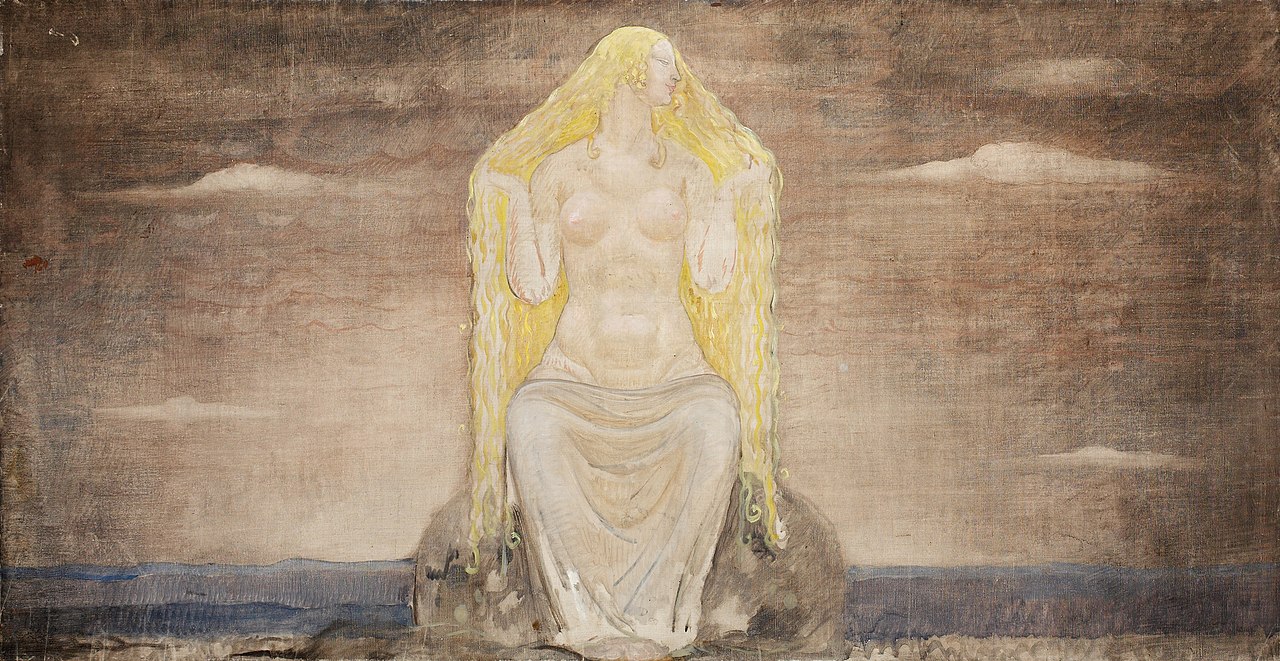
Vanir goddess of love, seiðr, and a share of the slain. Owns the necklace Brísingamen and the falcon cloak.
Freyja is a Vanir goddess and one of the most powerful deities in Norse mythology. She is the daughter of Njörðr and sister of Freyr. Her domains encompass love, beauty, sexuality, the magic of gold, and seiðr, the ritual art of prophecy and sorcery. According to Ynglingasaga, Freyja taught seiðr to the Æsir, placing her at the center of the Norse magical tradition. She lives in Fólkvangr, where her hall Sessrúmnir receives the warriors who fall in battle and are not chosen by Óðinn.
Brísingamen is Freyja's most celebrated possession. Snorri mentions the necklace in Gylfaginning, and the story of how she acquires it from four dwarves is told in Sörla þáttr, albeit in a late and Christianized version. The necklace is a central attribute in her iconography and is mentioned in kennings for gold. She also owns a falcon cloak that enables flight, which she lends to Loki in, among others, Þrymskviða and Haustlöng.
In Þrymskviða, Freyja plays a key role without even participating actively: the giant Þrymr steals Þór's hammer and demands Freyja as a bride price. Freyja refuses categorically and her rage is so great that Brísingamen cracks. Instead, Þór is disguised as a bride. The poem reveals Freyja's high standing and that the gods cannot hand her over as a commodity even to recover a crucial weapon.
Lokasenna 30-32 contains Loki's accusations against Freyja: that she has slept with all the Æsir and elves, including her brother Freyr. Freyja rejects the charges, but the poem reflects a tension in how Vanir goddesses were perceived in relation to Æsir norms. Hyndluljóð presents a different picture: here Freyja rides the boar Hildisvíni, who is her devotee Óttar in transformed shape, and she secures genealogical knowledge for him.
Freyja's weeping of gold is mentioned in Grímnismál and Snorric prose as an explanatory motif for gold in skaldic poetry. She weeps when her husband Óðr is away on long journeys. Who Óðr is and his relationship to Óðinn is an unresolved interpretive problem. Freyja searched for Óðr under different names, suggesting a myth cycle about separation and seeking that today is only partially preserved.
Sources in the Eddas
- Þrymskviða 1-32
- Þrymr demands Freyja as bride price for Þór's hammer. Freyja refuses and her Brísingamen is said to crack with rage. The poem is central to understanding Freyja's standing and her necklace.
- Lokasenna 30-32
- Loki directs sexual accusations at Freyja, claiming she has slept with all the Æsir and elves. Freyja responds and Óðinn intervenes. The passage is a key text for mythology's view of Freyja.
- Hyndluljóð 1-10
- Freyja rides the boar Hildisvíni, identified as Óttar in transformed shape, and seeks genealogical information from the giantess Hyndla. Reveals Freyja's role as a patron goddess and her deep ties to seiðr.
- Völuspá hin skamma (Hyndluljóð 29-44)
- The embedded fragment Völuspá hin skamma contains cosmological stanzas and mentions Freyja in eschatological contexts. The text's relationship to Völuspá is debated among philologists.
- Gylfaginning 24 och 35
- Snorri describes Freyja's attributes, Fólkvangr, Sessrúmnir, and her weeping of gold. The mention of Brísingamen and her falcon cloak are given here in prose form.
- Ynglingasaga 4
- Snorri states that Freyja taught seiðr to the Æsir, establishing her as the instructor of magic. The source is later but likely reflects older oral tradition.
- Haustlöng 13-15
- This skaldic poem by Þjóðólfr úr Hvini mentions Freyja's falcon cloak in connection with Iðunn's abduction. One of the earliest attestations of this attribute, dated to the 9th century.
Interpretive traditions
A What we know
Freyja is a Vanir goddess who, according to Ynglingasaga, taught seiðr to the Æsir; this establishes a distinct difference between the magical traditions of the Vanir and the Æsir.
She owns Brísingamen and a falcon cloak; both are attested in multiple independent sources and are considered original attributes.
She chooses half of the fallen warriors and receives them in Sessrúmnir in Fólkvangr, while Óðinn takes the other half to Valhöll, according to Gylfaginning 24.
B What we think we know
Whether Freyja and Frigg were originally the same goddess is debated; both weep for an absent husband, both are associated with sorcery, and their names may derive from the same proto-Germanic root.
Loki's accusations in Lokasenna are interpreted either as mythological fact, as ritual insult without historical core, or as a reflection of Vanir sexual norms contrasted with those of the Æsir.
The dating and authenticity of Sörla þáttr, which tells how Freyja acquires Brísingamen, is questioned by most scholars due to its late and Christianized form.
C What we do not know
Who Óðr actually is, why Freyja is married to him, and to what extent he is identified with Óðinn is genuinely unknown; the myth cycle about Freyja's search for Óðr is not preserved in coherent form.
Whether Freyja had an independent cult tradition separate from Freyr's, or whether they were worshipped jointly as a divine pair in ancient Scandinavia, is unknown.