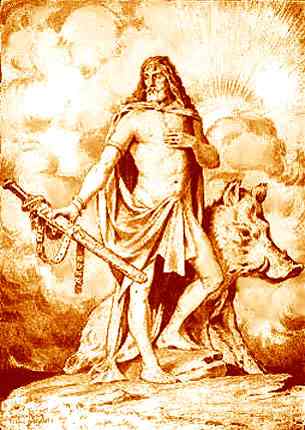
Vanir god of rain, sunshine, and fertility; brother of Freyja, son of Njörðr.
Freyr belongs to the Vanir, a group of gods associated with fertility, prosperity, and natural forces. He is the son of the sea god Njörðr and brother of Freyja. According to Grímnismál 5, he received Álfheimr as a tooth-gift, a realm he governs as lord of the light-elves. His name likely means 'lord' or 'prince', reflecting his standing as one of the most powerful gods in the Norse pantheon.
Skírnismál depicts Freyr's deepest crisis: sitting on Óðinn's high seat Hliðskjálf, he catches sight of the giantess Gerðr in Jötunheimr and falls immediately in love. He sends his servant Skírnir to win her with gifts, including his own invincible sword, which can fight on its own. Gerðr eventually agrees to meet Freyr after nine nights. This love story costs Freyr his most important weapon before Ragnarök.
Freyr owns two famous objects crafted by dwarves: the ship Skíðblaðnir, which always enjoys favorable winds and can be folded like a cloth, and the boar Gullinbursti, whose golden bristles shine in the dark and who can move faster than horses. Both are mentioned in Skáldskaparmál and Gylfaginning. These possessions reinforce his role as the god of gifts and abundance.
In Lokasenna, Loki mocks Freyr for having given away his sword and bought himself a wife with another's property. Freyr does not respond directly, but his servant Byggvir attempts to defend him. The episode underscores the sacrificial cost that love for Gerðr entailed. Freyr is also mentioned in Völuspá 53 as the one who at Ragnarök faces the fire giant Surtr without his sword and falls in the battle.
Freyr was intensely venerated in Viking-Age Scandinavia, especially in Sweden. Saxo Grammaticus and Icelandic sagas attest to sacrificial rites, processions with Freyr statues, and temples at Uppsala. He was thought to govern sun, rain, and good harvests. Freyr's cult was closely tied to royal power and fertility in a broad sense, and his name appears in numerous place names and personal names from the period.
Sources in the Eddas
- Skírnismál 1-42
- The entire poem depicts Freyr's love for Gerðr and how he sends Skírnir with gifts, including his own sword, to win her. Central to understanding Freyr's character and his sacrifice before Ragnarök.
- Grímnismál 5
- Óðinn lists Álfheimr as Freyr's home, given to him as a tooth-gift by the gods. The stanza confirms his lordship over the realm of the light-elves.
- Völuspá 53
- The seeress foretells that Freyr falls against Surtr at Ragnarök, armed without the sword he gave away for Gerðr's sake. One of the most dramatic consequences of the events in Skírnismál.
- Lokasenna 42-44
- Loki accuses Freyr of buying Gerðr with gold and giving away his sword. The servant Byggvir defends Freyr but without success. Reveals social tensions around Freyr's choices.
- Gylfaginning 24
- Snorri describes Freyr as the most excellent of the gods regarding prosperity, governing rain, sunshine, and the produce of the earth. The ship Skíðblaðnir and the boar Gullinbursti are presented here.
- Skáldskaparmál 7
- Snorri accounts for the works of the sons of Ívaldi, including Skíðblaðnir, and for Freyr's heiti and kennings. Poetic terminology tied to Freyr as a fertility god.
Interpretive traditions
A What we know
Freyr is one of the three Vanir gods named in the Eddas, alongside Freyja and Njörðr.
He was given Álfheimr as a tooth-gift according to Grímnismál 5; this is one of the few concrete topographical details about Freyr in the primary sources.
He surrendered his sword to Skírnir as payment for winning Gerðr, which Lokasenna and Völuspá confirm leads to his fall at Ragnarök.
B What we think we know
Whether Freyr was originally an independent deity or an aspect of an older proto-Germanic fertility god is debated; parallels with Tacitus's Nerthus have been proposed.
The relationship between Freyr and the historical Yngling kings of Sweden is interpreted differently: some scholars see Freyr as a euhemeristic king, others as a purely mythological figure.
It is disputed whether Skíðblaðnir and Gullinbursti were Freyr's possessions from the outset or were attributed to him secondarily in the Snorrian systematization.
C What we do not know
Freyr's mother's identity is never mentioned in the surviving Eddic texts; who she is and what role she played in Vanir mythology remains unknown.
How Freyr's cult was actually practiced in detail at Uppsala and other cult sites is unknown, as the archaeological and written sources are fragmentary and often late.