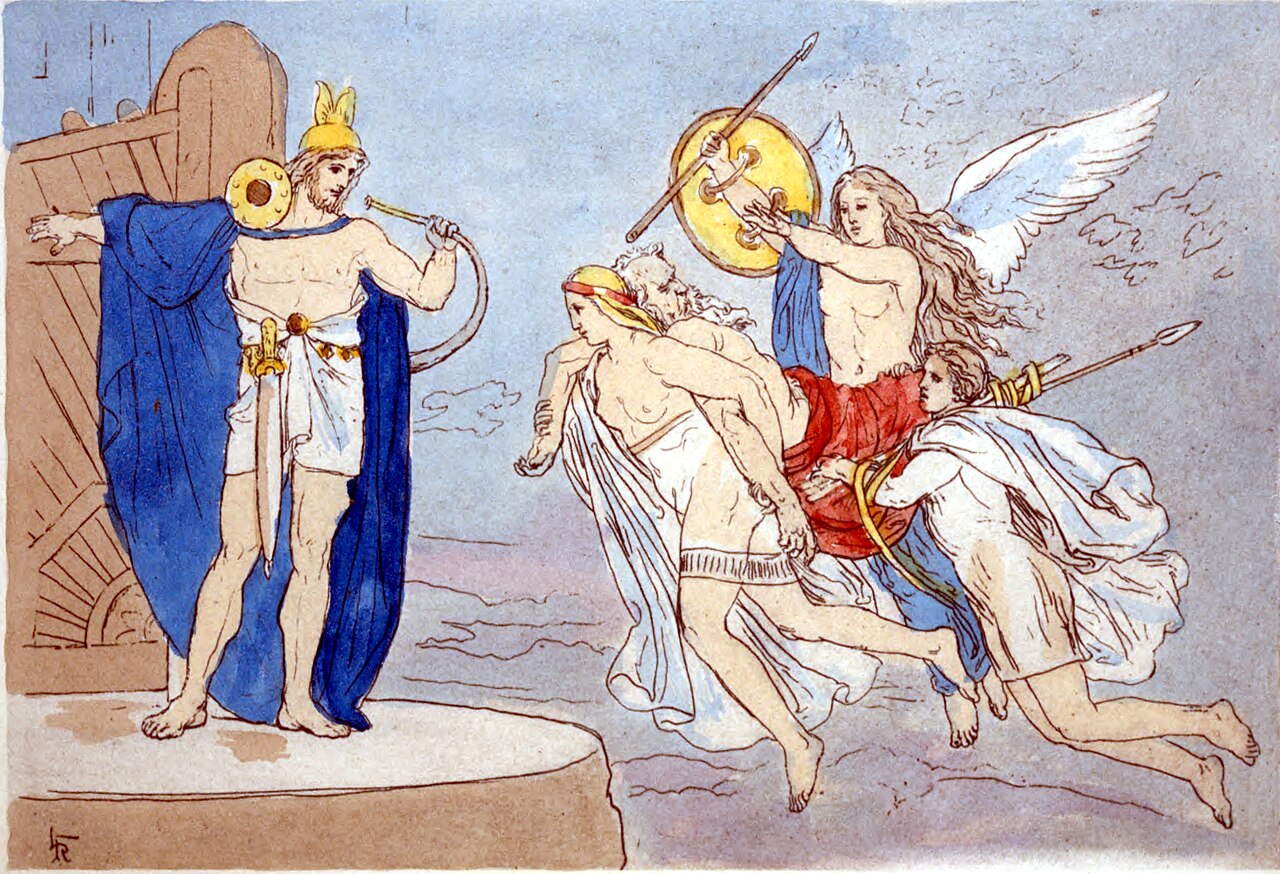
Watchman of the gods at Bifröst. Owns the horn Gjallarhorn and hears grass grow. Father of the three estates in Rígsþula.
Heimdall (Old Norse Heimdallr) is the Aesir's watchman at Bifrost, the rainbow bridge connecting Asgard to the other worlds. He is described in Grímnismál 13 and Gylfaginning 27 as the whitest of the Aesir, with the ability to see and hear equally well by night and day, and to hear grass grow and wool grow on sheep. His horn Gjallarhorn resounds through all worlds and will be blown to summon the gods to Ragnarok.
Heimdall's origin is unusual: he has nine mothers (Hyndluljóð 35-38), all giantesses, often identified in scholarship with the daughters of Aegir, the ocean waves. This polymaternal ancestry places him in a cosmological borderland, consistent with his function as guardian at the boundary between worlds. The connection to the sea and the waves is a scholarly hypothesis, not directly attested in Hyndluljóð.
In Rígsþula Heimdall appears in the guise of Rig, a wandering god who visits three human households and fathers the ancestors of three classes: thralls (Þræll), farmers (Karl), and nobles (Jarl). The final stanzas imply that Rig/Heimdall taught Jarl runes, linking Heimdall to a teaching and civilizing role that complements his watchman service.
At Ragnarok Heimdall battles Loki; they kill each other mutually (Völuspá 51). A difficult kenning in skaldic poetry, 'Heimdall's head', leads some scholars to postulate that his mythological role includes sacrifice or cosmogonic function. Another key text is Þrymskviða 15, where Heimdall 'knew well the future as the Vanir do' and proposes that Thor dress as a bride, suggesting cunning and foresight as attributes of the deity.
Sources in the Eddas
- Völuspá 27; 51
- Stanza 27 mentions Heimdall's Gjallarhorn. Stanza 51 states his mutual killing with Loki at Ragnarok.
- Grímnismál 13
- Heimdall's hall Himinbjorg at Bifrost is named; he dwells at the end of the sky bridge.
- Rígsþula 1-48
- Heimdall in the role of Rig creates the three social classes by fathering children in three households; the poem links him to social order and runic knowledge.
- Hyndluljóð 35-38
- Heimdall's nine mothers are named; they are identified as Aegir's daughters and representatives of the ocean waves.
- Þrymskviða 15
- Heimdall proposes that Thor disguise himself as a bride to recover Mjölnir. The stanza says he 'knew well the future as the Vanir do'.
Interpretive traditions
A What we know
Heimdall is the Aesir's guardian at Bifrost and possesses Gjallarhorn, attested in Völuspá, Grímnismál, and Gylfaginning.
He kills and is killed by Loki at Ragnarok (Völuspá 51).
In Rígsþula he is identified as Rig and linked to the origin of the three social classes.
B What we think we know
Whether Heimdall originally belonged to the Vanir rather than the Aesir, as Þrymskviða 15 may suggest, is debated.
The kenning 'Heimdall's head' (= the sword) in skaldic poetry and its implications for a sacrificial role has been interpreted but is not consensus-established.
C What we do not know
The exact cosmogonic or theogonic function of Heimdall's nine-mothers myth is not explained in the sources.
Whether Heimdall had dedicated cult sites or cult practice beyond his mythological role is unknown.