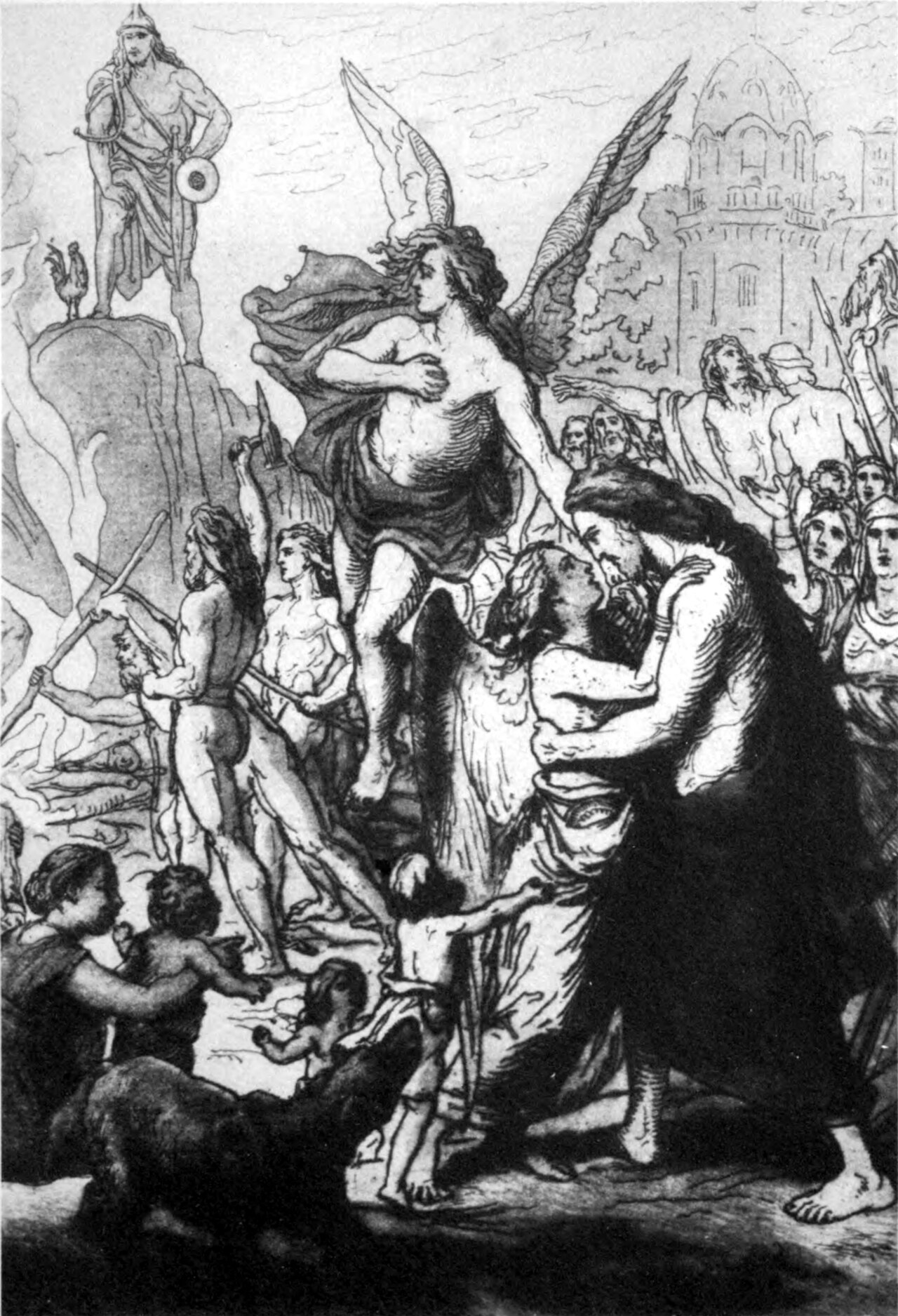
Goddess who keeps the apples that keep the Æsir young. Wife of Bragi.
Idunn (Old Norse Iðunn) is an Asynj a and wife of Bragi, the god of skaldic poetry. Her central mythological function is to guard and distribute the golden apples that preserve the youth and immortality of the Aesir. The apples are mentioned in Lokasenna 17 and described in detail in Skáldskaparmál (Haustlöng, the poem of Þjóðólfr). Without them the Aesir grow old and lose their strength.
The surviving myth about Idunn centers on her abduction by the giant Þjazi, accomplished through Loki's treachery. Loki had been captured by Þjazi and promised to deliver Idunn with her apples in exchange for his freedom. He then lured Idunn out of Asgard on the pretext of having found remarkable apples in the forest; Þjazi descended as an eagle and carried her to Thrymheim. The Aesir aged rapidly and sought out Loki, who was compelled to rescue Idunn. He transformed into a falcon, bore her in the shape of a nut, and fled; Þjazi was killed in the Aesir's fires at Asgard's gates (Skáldskaparmál, ch. 1-2).
Idunn's role as guardian of the apples places her in a function of cosmological necessity: the divinity of the Aesir depends on her service and is conditional rather than intrinsically eternal. Þjóðólfr's skaldic poem Haustlöng (ca. 900) is the oldest source and describes the events in kenning-dense stanzas. The poem shows that the Idunn myth circulated in skaldic tradition already in the 10th century, likely with roots in an older oral tradition.
Lokasenna 17 accuses Idunn of being the most man-mad of all goddesses for having embraced her brother's killer, but the exact meaning of the accusation is difficult to interpret and may refer to a now-lost mythic variant. Her marriage to Bragi forms a natural pairing: the god of poetry and the goddess who sustains the life-force and inspiration of the gods.
Sources in the Eddas
- Lokasenna 16-17
- Idunn defends her husband Bragi against Loki, whereupon Loki turns on her with a difficult-to-interpret charge about her affections.
- Hávamál 104
- A stanza in Hávamál is taken by some interpreters to allude to Idunn in an apple context, but the attribution is uncertain.
Interpretive traditions
A What we know
Idunn guards golden apples that maintain the youth of the Aesir; this is Snorri's explicit account in Gylfaginning 26 and Skáldskaparmál.
She was abducted by Þjazi with Loki's complicity and retrieved by Loki in falcon form; this is attested in Skáldskaparmál and Haustlöng (ca. 900).
She is married to Bragi, the god of poetry.
B What we think we know
Whether the apples symbolize an older Indo-European fruit of immortality (compare the apples of the Hesperides in Greek myth) or represent an independent Norse tradition is debated.
The accusation in Lokasenna 17 is semantically difficult and interpretations vary considerably among philologists.
C What we do not know
Idunn's cult, if one existed, is archaeologically undocumented.
The theological basis for the apples' power, whether cosmological, botanically symbolic, or ritual, is not explained in the sources.