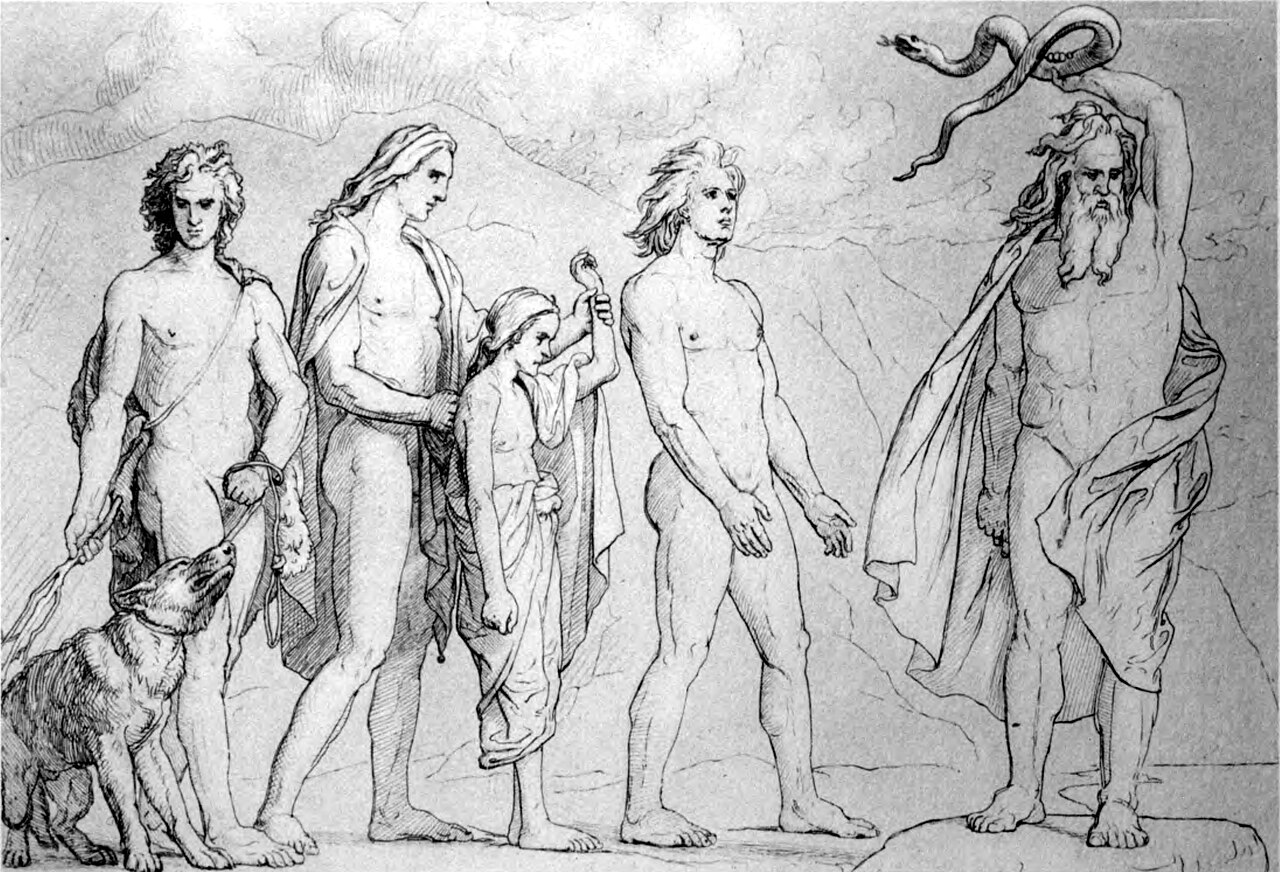
Son of Fárbauti and Laufey. Shapeshifter; father of Fenrir, Jörmungandr, and Hel, and mother of Sleipnir. Causes Baldr's death and is bound until Ragnarok.
Loki is one of the most complex figures in Norse mythology. He is the son of the giant Fárbauti and Laufey (also called Nál) and is thus of giant lineage, an outsider among the Æsir. Yet he lives in Ásgarðr and is Óðinn's blood-brother, a relationship sometimes mentioned in the poetic sources. Loki is a shapeshifter and cunning schemer whose interventions sometimes help the gods and sometimes create catastrophe. His ambivalence makes him a figure without real parallel in Indo-European mythology.
Loki is the father of three of the most feared beings in Norse mythology. With the giantess Angrboða he fathered the wolf Fenrir, the Midgard Serpent Jörmungandr, and the ruler of the realm of the dead, Hel. In addition, in the shape of a mare, he is the mother of the eight-legged horse Sleipnir, whom he gives birth to after being covered by the stallion Svaðilfari. These offspring and the mother episode are given in Gylfaginning 34 and 42. Loki's biological multiplicity symbolizes his boundless malleability.
Lokasenna is the poem that defines Loki's relationship with the gods in its crisis form. Loki forces his way into Ægir's feast, kills a servant, and refuses to leave, systematically insulting all the gods and goddesses one by one. The poem is a systematic excavation of the gods' hidden shames and secrets. Loki exposes incest, cowardice, oath-breaking, and sexual conduct that undermines divine authority. He is silenced only when Þór arrives with his hammer.
The Baldr myth is Loki's most fateful act. He manipulates the blind god Höðr into throwing the mistletoe at Baldr, the only one who is vulnerable, and then prevents Baldr from returning from Hel by refusing to weep. Baldrs draumar and Gylfaginning 49 depict these events. As punishment, Loki is captured, bound with the entrails of his son Narfi beneath a rock, and a serpent drips venom onto his face until Ragnarök. His wife Sigyn holds a bowl beneath the serpent, but when she empties it, Loki writhes and causes earthquakes.
At Ragnarök Loki's bonds break. He steers the ship Naglfar, built from the nails of the dead, with an army of giants against the gods. Völuspá 51 and Gylfaginning 51 depict his final confrontation with the order of the gods. Loki falls in battle against Heimdallr, and both die of each other's wounds. Loki's categorical belonging is debated in scholarship: he is neither a pure Æsir, Vanir, nor giant, making him a permanent boundary-transgressor in the mythology.
Sources in the Eddas
- Lokasenna 1-65
- The entire poem revolves around Loki and his accusations against the other gods at Ægir's feast. The richest single source for Loki's character, his relationship with the gods, and his role as exposer of shame.
- Völuspá 35, 51, 65
- Völuspá mentions Loki's binding (stanza 35), the ship Naglfar and his release at Ragnarök (51), and his battle against Heimdallr (65). Three key stanzas for Loki's eschatological role.
- Þrymskviða 1-32
- Loki helps Þór recover Mjölnir through cunning and disguise. The poem shows Loki's constructive side: he is the gods' problem-solver when the situation demands diplomacy rather than strength.
- Hymiskviða 37
- Loki is mentioned in connection with the divine feast and the brewing cauldron; his role in the context illuminates how he moves in the boundary zone between the spheres of gods and giants.
- Baldrs draumar 1-14
- The poem foretells Baldr's death and Loki's role in it. Óðinn rides to Hel to question a dead seeress. Loki's actions are described indirectly as the root of the ominous sequence leading to Ragnarök.
- Gylfaginning 34, 42, 49, 51
- Snorri provides the most detailed prose account of Loki's children (34), his fostering of Sleipnir (42), Baldr's death and Loki's punishment (49), and his release at Ragnarök (51). Key source for Loki's entire narrative.
- Skáldskaparmál 16-17
- Snorri accounts for Loki's theft of Brísingamen and his duel with Heimdallr in the form of seals, providing supplementary material on the mythological conflict between the two gods.
- Hrafnagaldr Óðins 6
- A late and difficult poem that mentions Loki in cosmological contexts. The text is contested but provides additional illumination of Loki's position in Norse cosmology near Ragnarök.
Interpretive traditions
A What we know
Loki is the son of the giant Fárbauti and Laufey and is biologically of giant lineage; this is consistent across all primary sources.
He is the father of Fenrir, Jörmungandr, and Hel with Angrboða, and the mother of Sleipnir, born after Loki took mare-shape; Gylfaginning 34 and 42 confirm both.
He causes Baldr's death by manipulating Höðr and then prevents Baldr's return; this is attested in both poetic and prose primary sources.
He is bound beneath a rock with Narfi's entrails and tormented by serpent-venom until Ragnarök, whereupon his writhing causes earthquakes; Völuspá 35 and Gylfaginning 50 confirm this.
B What we think we know
Whether Loki was originally an independent mythological figure or a relatively late construction to account for evil and chaos in an otherwise god-dominated cosmology is intensely debated by scholars such as Georges Dumézil, Folke Ström, and Anna Birgitta Rooth.
The connection between Loki and fire is disputed; earlier scholarship saw him as a fire god, but this interpretation is now questioned since no primary source directly associates Loki with fire as an element.
Whether Loki is a type of trickster figure with parallels in shamanic traditions, or a genuinely Norse creation without direct extra-Scandinavian models, remains an open question.
C What we do not know
Whether Loki was worshipped cultically in pre-Christian Scandinavia is genuinely unknown; no temples, altars, or archaeological finds have been securely linked to a Loki cult, and he lacks a weekday name unlike Óðinn, Þór, Týr, and Frigg.
Loki's exact relationship to Óðinn as blood-brothers and what this bond originally meant in mythological and cultic terms is unknown; the sources imply the bond but never explain it.
Why Loki aids the gods for a long period and then turns against them is unknown; whether this reflects an original mythological logic or is a compilation artifact from the hand of Christian saga-writers cannot be determined with current source material.