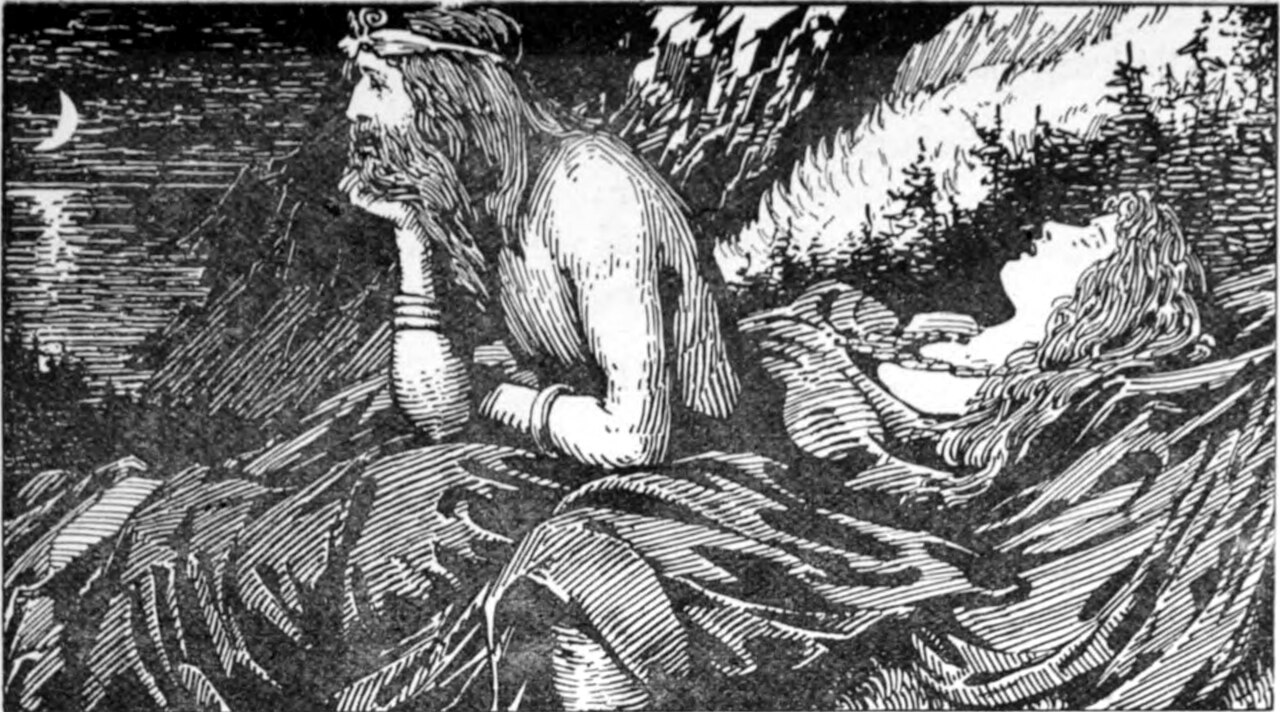
Vanir god of the sea, wind, and prosperity. Dwells at Nóatún. Father of Freyr and Freyja.
Njörðr is one of the three Vanir gods named in the Eddas, father of Freyr and Freyja. He rules over the sea, winds, and fishing and is thought to grant prosperity to those who seek his aid. His home is Nóatún, 'the boat place', a name that directly ties him to coast and seafaring. Njörðr was part of the hostage exchange following the war between the Vanir and the Æsir, and he settled permanently among the Æsir in Ásgarðr.
Njörðr's marriage to the giantess Skaði is one of the most widely told episodes in Norse mythology. Skaði came to Ásgarðr to avenge her father Þjazi's death and was offered as compensation the right to choose a husband from among the gods, but was allowed to see only their feet. She chose the most beautiful feet, believing they belonged to Baldr, but they were Njörðr's. Gylfaginning 23 and the prose prologue to Skírnismál give parts of this narrative.
The compromise between the spouses was that they would alternate, spending nine nights at Skaði's mountain home Þrymheimr and nine nights at Njörðr's coastal home Nóatún. The arrangement did not work: Njörðr hated the wolf-howls in the mountains and Skaði hated the seagulls at the coast. They separated and Skaði returned to Þrymheimr. The story is preserved in detail by Snorri in Gylfaginning and echoed poetically in Grímnismál 16.
In Lokasenna 34-38, Loki accuses Njörðr of having fathered Freyr and Freyja with his sister, a relationship permitted among the Vanir but unacceptable among the Æsir. Njörðr responds calmly that this union nonetheless produced one of the best of gods. The exchange reflects the mythological tension between the differing customs of the two divine groups.
Tacitus mentions in Germania 40 a goddess named Nerthus, who may be linguistically and mythologically related to Njörðr. Nerthus was worshipped on an island in the sea and a famous processional cult is attested. The relationship between Nerthus and Njörðr is disputed, but the connection suggests that Njörðr's cult may have roots in older Germanic fertility traditions linked to earth and water.
Sources in the Eddas
- Grímnismál 16
- The stanza describes Njörðr's home Nóatún and his love of the sea. One of the briefest but clearest poetic descriptions of Njörðr in the Poetic Edda.
- Lokasenna 34-38
- Loki accuses Njörðr of incest with his sister; Njörðr concedes the relationship but notes that Freyr was born of it. The exchange is central to understanding the differences between Vanir and Æsir norms.
- Gylfaginning 23
- Snorri tells of Skaði's arrival, the choosing of a husband via feet, and the failed marital cohabitation. The most detailed source for the Njörðr-Skaði myth and their mutual incompatibility.
- Skírnismál, prolog (prosa)
- The prose introduction to Skírnismál introduces Njörðr as Freyr's father and mentions his home Nóatún. Brief but important for the genealogical context.
- Völuspá 21-24
- Recounts the Vanir War and the hostage exchange through which Njörðr and his children came to the Æsir. Establishes Njörðr as part of the consequences of the mythological war and the peace between the divine groups.
- Skáldskaparmál 1
- Snorri provides kennings for Njörðr and his role as lord of the sea. An important complement to the Eddic poetic texts for understanding how skalds referred to Njörðr.
Interpretive traditions
A What we know
Njörðr was part of the hostage exchange after the Vanir War and settled among the Æsir; this is confirmed by Völuspá and Snorri.
His marriage to Skaði ended in separation due to incompatibility between coast and mountain; both Snorri and Grímnismál confirm this.
He is the father of Freyr and Freyja and is counted among the Vanir despite his permanent residence in Ásgarðr.
B What we think we know
The linguistic and mythological connection between Njörðr and Tacitus's Nerthus is debated in scholarship; a direct relationship is possible but unproven.
Whether the mother of Freyr and Freyja is Njörðr's sister, as Lokasenna implies, or another figure, is debated; no source names the mother.
Njörðr's actual cultic function in pre-Christian Scandinavia is disputed; it is unclear whether he was primarily venerated as a god of seafaring, a fertility god, or a combination of both.
C What we do not know
Njörðr's origins among the Vanir and the details of his life before the hostage exchange are entirely unknown; no source preserves a coherent Vanic prehistory for him.
Whether Njörðr had an institutionalized priesthood or specific temples dedicated to him, distinct from the more general Vanir cult sites, is unknown.