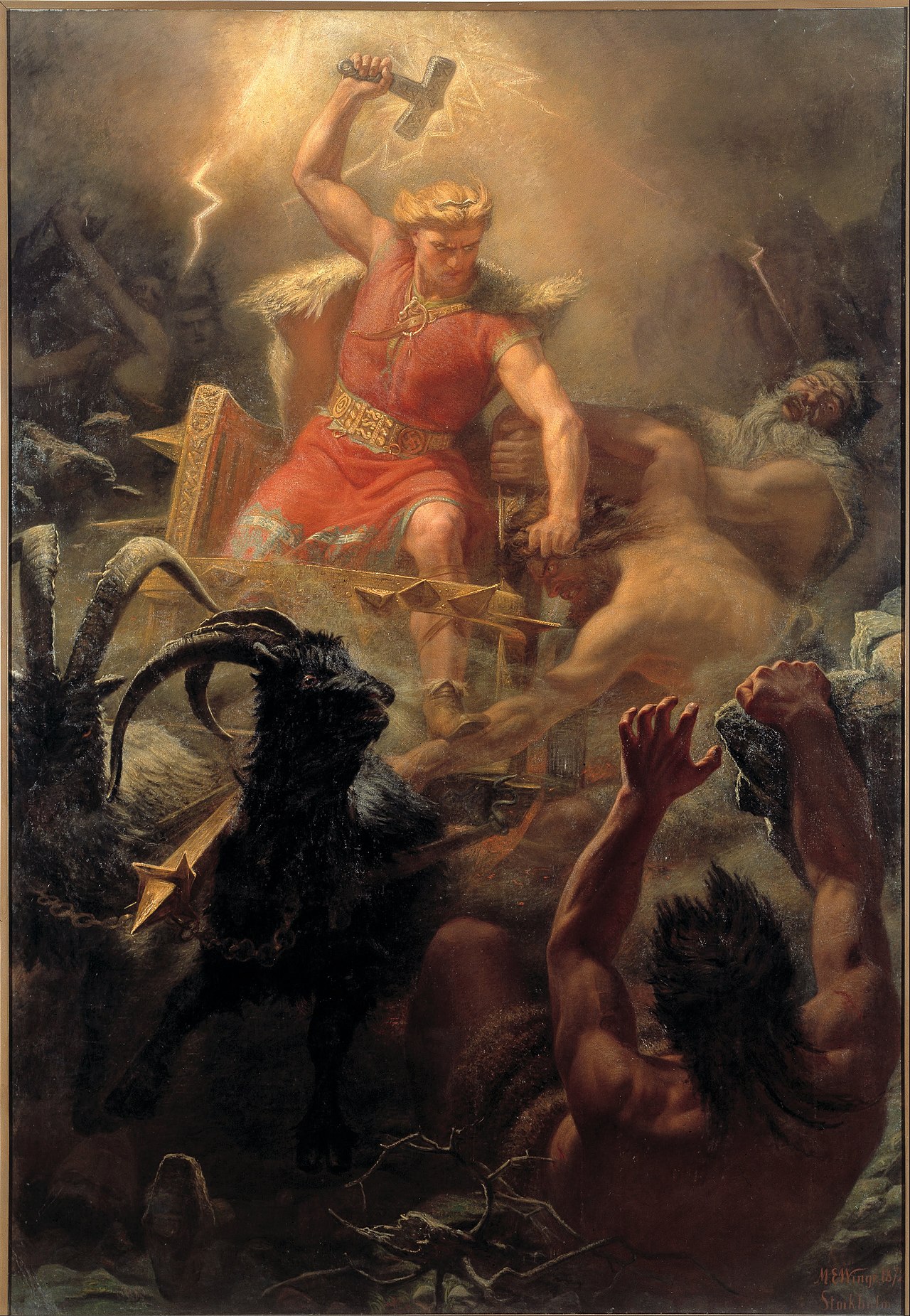
The thunder god; son of Odin by the giantess Jörð. Bears Mjöllnir, the belt Megingjörð, and the iron gauntlets.
Thor (Old Norse Þórr) is the son of Odin and the earth-giantess Jord, and the physically strongest of the Aesir. He personifies thunder and emerges in the sources as the god of the common people; where Odin is worshipped by princes and poets, Thor is the protector of farmers and warriors. His wife is Sif of the golden hair, and he has two sons, Magni and Modi, as well as a daughter, Thrud.
Thor's most important attribute is the hammer Mjölnir, forged by the dwarfs Sindri and Brokk (Skáldskaparmál). The hammer is used to crush giants, bless marriages, and hallow the dead. He drives a chariot pulled by two goats, Tanngrisnir and Tanngnjóstr, which he can slaughter and revive, a feature depicted in Gylfaginning 44. His iron gauntlets and strength belt Megingjord are necessary to wield Mjölnir.
Thor's battles with giants constitute a large portion of the Eddic material. Hymiskviða recounts the fishing expedition for the Midgard Serpent and the confrontation with the giant Hymir. Þrymskviða tells how Mjölnir was stolen by the giant Thrym and how Thor recovered it dressed as a bride. Hárbarðsljóð is a flyting between Thor and a disguised Odin, in which Odin's intellectual superiority is set against Thor's physical strength, to Thor's disadvantage.
In Lokasenna 60 Thor threatens Loki with Mjölnir and forces him to fall silent. At Ragnarok Thor meets Jörmungandr in combat; they slay each other, and Thor takes nine steps before the venom fells him (Völuspá 56). The myth of Thor's visit to Utgard-Loki (Gylfaginning 44-47) demonstrates how the magic of the outer world can outwit even supreme physical strength.
Archaeological finds, including large numbers of Mjölnir amulets from the Viking Age, and Scandinavian place names with the Thor element attest to a widespread popular cult. The weekday Thursday (Old English Þūnresdæg) reflects a continental Germanic parallel to the Old Norse deity.
Sources in the Eddas
- Hymiskviða 1-39
- Thor fishes for the Midgard Serpent and battles the giant Hymir; Mjölnir and the goats are mentioned.
- Þrymskviða 1-32
- The theft of Mjölnir by the giant Thrym and Thor's disguise as a bride to recover it.
- Hárbarðsljóð 1-60
- Flyting between Thor and the disguised Odin (Harbard); Thor's physical exploits are contrasted with Odin's cunning.
- Völuspá 56
- Thor's and Jörmungandr's mutual destruction at Ragnarok: Thor takes nine steps before the venom kills him.
- Lokasenna 58-65
- Thor arrives and threatens Loki with Mjölnir, forcing Loki to end his insults.
- Álvíssmál 1-35
- Thor questions the dwarf Alvis on cosmological knowledge and keeps him talking until dawn turns him to stone.
Interpretive traditions
A What we know
Thor is the strongest of the Aesir and is linked to thunder, attested in all core Eddic and skaldic sources.
Mjölnir is his central attribute, used both to fight giants and to hallow rites.
His cult was widespread among the farming class; this is supported by archaeological Mjölnir amulets and place names.
He falls at Ragnarok from Jörmungandr's venom after slaying the serpent (Völuspá 56).
B What we think we know
Whether Thor or Odin was the more widely worshipped god during the Viking Age likely varied by region and social class, but the evidence is not unambiguous.
The Utgard-Loki myth (Gylfaginning 44-47) is interpreted either as ancient tradition or as Snorri's literary invention.
C What we do not know
The exact relationship between Thor and other Indo-European thunder deities (e.g., Vedic Indra, Baltic Perkūnas) has not been definitively established.
Whether Thor's goat symbolism (Tanngrisnir and Tanngnjóstr) has a cultic background or is purely narrative is unclear.