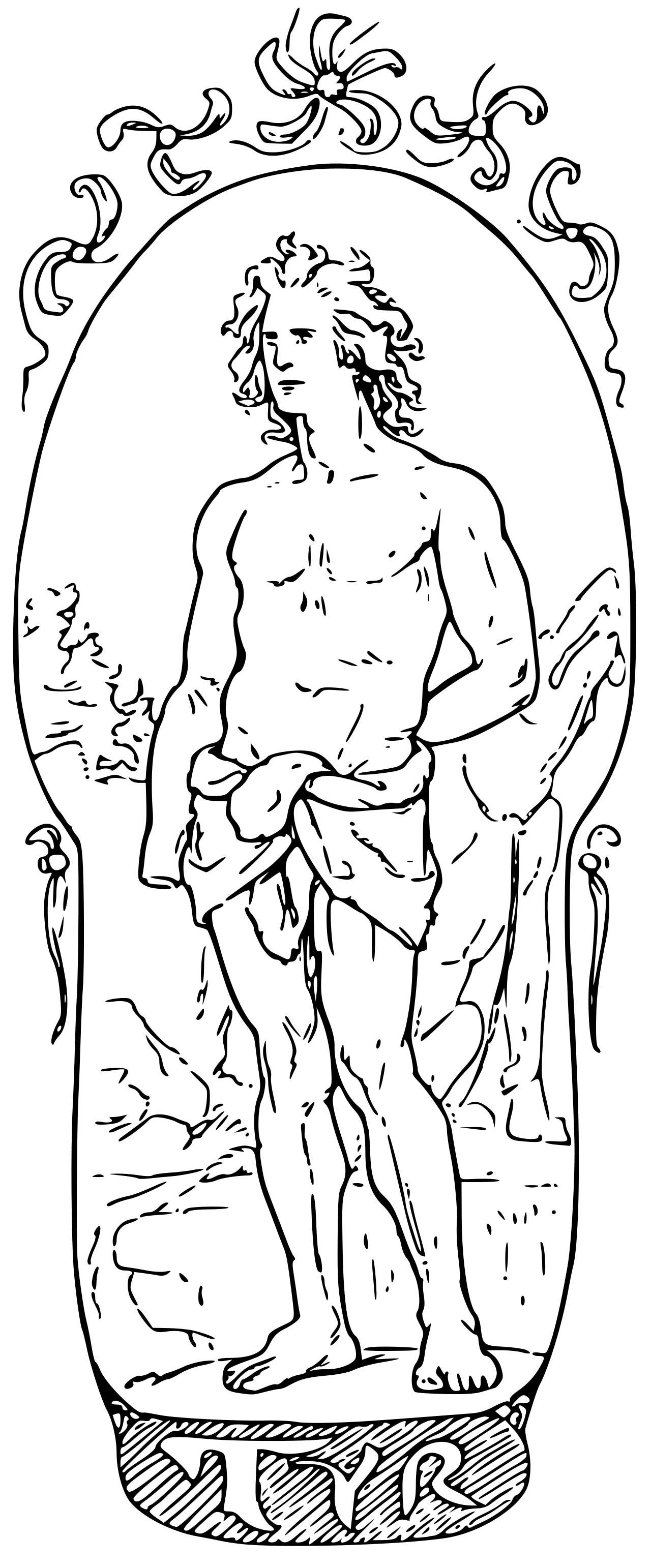
God of war, law, and the oath. Loses his hand when Fenrir is bound with Gleipnir.
Tyr (Old Norse Týr) is the Aesir god of war, law, and oaths. His name is cognate with Proto-Indo-European *dyeus ('sky god', 'shining god') and Proto-Germanic *Tiwaz, linking him to Vedic Dyaus and Greek Zeus. He was likely one of the central deities of the oldest Germanic pantheon, but in the Eddic sources his role is reduced compared to what the etymology implies.
Tyr's most famous myth is the sacrifice of his hand in the binding of the wolf Fenrir with the magical fetter Gleipnir. The Aesir promised Fenrir they would release him if the fetter held, but the promise was false. Fenrir distrusted the Aesir and demanded that a god place his hand in his jaws as a pledge. Only Tyr dared, and when the wolf could not break free he bit off the hand at 'the wolf's joint' (Gylfaginning 34, Lokasenna 38). The hand-sacrifice is semantically close to the principle of oath tradition: a broken oath exacts a physical price.
In Hymiskviða 5 Tyr is named as the son of the giant Hymir, an instance of the mythological tradition in which gods can have giant ancestry on one side. He accompanies Thor to Hymir's hall to retrieve a large cauldron for the gods' brewing. Lokasenna 38-40 contains Loki's accusation that Tyr's wife bore him a son; Tyr's rebuttal is weak, and Loki notes that Tyr always loses in every dispute.
Place names with the Tyr element are attested in Scandinavia and the British Isles, indicating he was an object of cult worship. The weekday Tuesday (Old English Tīwesdæg) is named after *Tiwaz, showing the cult extends back to Proto-Germanic times. In North Germanic tradition he appears to have lost his primary role as sky god to Odin and Thor, while retaining a law and oath function.
Sources in the Eddas
- Hymiskviða 1-3
- Tyr is introduced as Hymir's son and he initiates the expedition to retrieve a cauldron for the gods' feast.
- Lokasenna 38-40
- Loki charges Tyr on two counts: his wife's infidelity and that he always loses disputes. Tyr cannot rebut the charges effectively.
- Gylfaginning 51
- Tyr is killed by Garm, Hel's hound, and kills it in turn at Ragnarök.
Interpretive traditions
A What we know
Tyr sacrificed his hand in the binding of Fenrir with Gleipnir; this is attested in Gylfaginning 34 and alluded to in Lokasenna 38.
His name connects etymologically to Proto-Indo-European *dyeus, indicating origins as a sky god.
He dies at Ragnarök after mutually killing Garm (Gylfaginning 51).
B What we think we know
Whether Tyr was originally the paramount deity of the common Germans and was secondarily displaced by Odin is a central but contested thesis (de Vries, Dumézil).
The relationship between his giant ancestry (Hymiskviða) and his divine role is not clarified in the sources.
C What we do not know
The extent to which Tyr was actually worshipped with dedicated cult sites in Viking Age Scandinavia is unknown, as direct archaeological evidence is lacking.
His identification with Mars Thingsus on a Roman inscription in Britain has been interpreted but is not definitively understood.