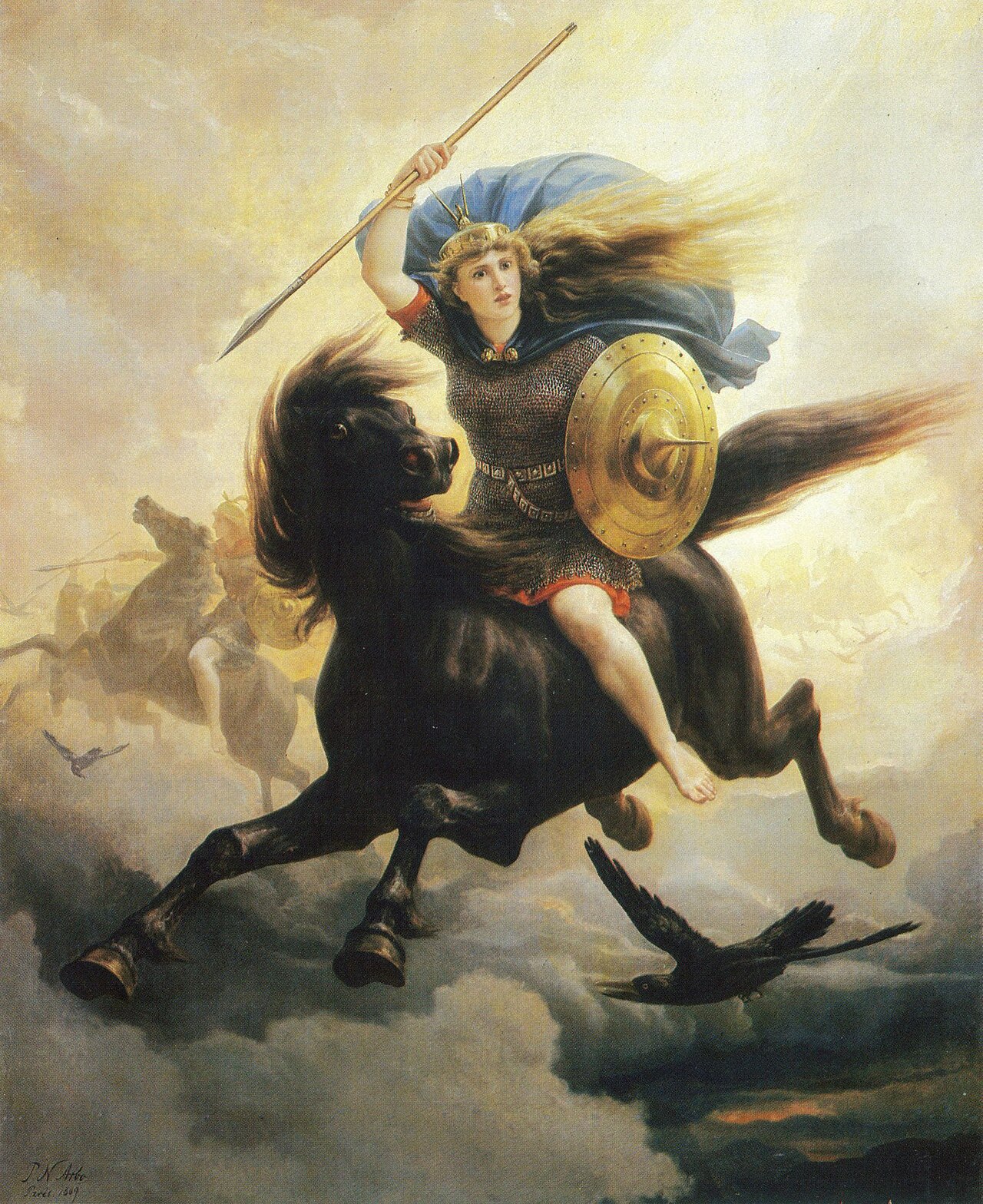
Odin's battle-maidens who choose the slain and bear them to Valhöll.
The valkyries are Odin's battle-maidens tasked with choosing the slain on the battlefield and bearing them to Valhöll. Their name is composed of Old Norse valkr (the fallen) and kjósa (to choose), and their function as fate-determining beings on the field of battle links them to the norns. Völuspá 30 depicts the valkyries riding out, armed and ready, to distribute the outcome of battle among the gods' enemies.
The names of individual valkyries appear in Grímnismál 36, where Hrist, Mist, Skeggjold, Skögul, Hildr, Þrudr, Hlökk, Herfjötur, Göll, Geirönul, Randgridr, Raðgridr, and Reginleif are listed as servers of Valhöll. Brynhildr is the most literarily developed valkyrie, portrayed in the Volsung cycle as a sleeping warrior-woman whose fate is intertwined with Sigurðr's. Sigrun and Svafa are heroic women in the Helgakviður who display similar features.
The valkyries' dual role, as battlefield goddesses and cupbearers, is a central characteristic. In Helgakviða Hjörvarðssonar, the hero Helgi encounters a valkyrie on horseback, and the dialogue between them is the only instance in the Eddic poems where a valkyrie gives a human her name and initiates a love relationship. This romanticized aspect is, however, likely a literary layer overlaid on an older cultic function.
In Lokasenna, Loki accuses the valkyries of having shared beds with human heroes, suggesting their relationship to the heroes was not always perceived as purely ritual. Göndul and Skögul are named in Hákonarmál as the valkyries Odin sends to choose King Hákon for Valhöll, showing the tradition was alive in skaldic poetry as late as the tenth century.
Sources in the Eddas
- Völuspá 30
- Depicts the valkyries riding out over the battlefield to determine the outcome of battle.
- Grímnismál 36
- Lists thirteen valkyries by name as servers of mead in Valhöll.
- Helgakviða Hundingsbana I 1-6
- Sigrun, identified as a valkyrie, determines the hero's fate from birth.
- Helgakviða Hjörvarðssonar 5-8
- The only Eddic dialogue in which a valkyrie gives her name to a mortal and initiates a love relationship.
- Hákonarmál 1-3
- Gondul and Skögul are sent by Odin to choose King Hákon for Valhöll, a tenth-century poem.
Interpretive traditions
A What we know
Valkyries choose the fallen on the battlefield at Odin's behest and bear them to Valhöll, attested in Völuspá and Grímnismál.
They serve mead in Valhöll, a function clearly attested in Grímnismál 36.
Brynhildr, Sigrun, and Svafa are the most fully developed individual valkyries in Eddic poetry.
B What we think we know
It is debated whether the valkyries were originally fate-goddesses (similar to norns) and whether the battlefield function is primary or secondary.
Whether valkyries received cultic veneration in pre-Christian times or are purely poetic figures is contested.
C What we do not know
It is unknown to what extent valkyrie beliefs varied regionally across the Old Norse world.
The valkyries' relationship to Continental Germanic fate-goddess concepts has not been fully resolved.